Posted on

STATE NEWS – Presumptive Medicaid eligibility for pregnant Arkansans set to go into effect

STATE NEWS – Presumptive Medicaid eligibility for pregnant Arkansans set to go into effect


Alternative Headline: AR Expands Medicaid for Moms

[MM Curator Summary]: Arkansas will begin offering presumptive Medicaid eligibility to pregnant women in August to improve maternal health outcomes. 

====================================


Arkansas lawmakers reviewed two rules Wednesday in response to a new law aimed at improving the state’s maternal health care landscape for low-income pregnant women.

The Joint Public Health, Welfare and Labor Committee spent nearly an hour discussing Arkansas’ new policy of presumptive Medicaid eligibility for pregnant women, part of the Healthy Moms, Healthy Babies Act that will go into effect in August.

Presumptive eligibility assumes 60 days of Medicaid eligibility and shortens the process of applying for coverage. The policy was among several recommendations to improve the state’s maternal health care landscape that a task force convened by Gov. Sarah Huckabee Sanders issued in September 2024.

More than half of births in Arkansas are covered by Medicaid, the federal-state health insurance system for low-income Americans. A federal budget bill moving through Congress would make deep cuts to Medicaid spending, reducing the program by $625 billion over 10 years.

Elizabeth Pitman, director of the Division of Medical Services for Arkansas Medicaid, said she anticipates the proposed cuts will affect the state’s Medicaid expansion population but not pregnant women on Medicaid.

Arkansas has among the nation’s highest maternal mortality and infant mortality rates. Rep. Jack Ladyman, R-Jonesboro, said he found this frustrating and considered presumptive Medicaid eligibility “a very good cornerstone” for improving these statistics.

Ladyman and Rep. Lee Johnson, R-Greenwood, asked Pitman and other Department of Human Services officials how they plan to ensure that pregnant Arkansans statewide have the information and resources they need to opt into presumptive Medicaid eligibility if applicable.

“I want to support this rule, but I also want to be realistic in what we expect the outcome of this rule to be,” said Johnson, an emergency medicine physician. “If we pass this eligibility category and nobody’s applying for it any more often than they’re currently applying for Medicaid, then it’s not moving the needle.”

Pitman said DHS can address Johnson’s concerns about access to information in its focus groups with pregnant Arkansans. She also said the agency will work with community health workers, doulas and other local health care providers and community organizations to ensure the option of presumptive Medicaid eligibility is as widely known as possible.

DHS learned during the three-year public health emergency of the COVID-19 pandemic that spreading information about public health resources via social media, digital billboards and doctor’s offices successfully reaches the agency’s target audience, state Medicaid Director Janet Mann said.

In January, Arkansas received a 10-year, $17 million federal grant aimed at improving maternal health outcomes for Medicaid recipients. Applying for the grant was among the maternal health task force’s recommendations last year.

The grant includes payments to healthcare providers as incentives for improved data-sharing on maternal health outcomes, Pitman said.

In response to more questions from Johnson, Pitman said DHS does not have data on whether pregnant Arkansans’ first interactions with prenatal health care occur in primary care providers’ offices or emergency rooms.

Arkansas remains the only state that has taken no action to adopt the federal option of extending postpartum Medicaid coverage from 60 days to 12 months after birth, according to KFF. The maternal health task force did not recommend this policy, and a bill to create it failed in a Senate committee in April after Pitman and Mann expressed DHS’ opposition to it.

The other rule the joint committee reviewed Wednesday was the “unbundling” of billing rates for labor and delivery, a policy also put forth by the Healthy Moms, Healthy Babies Act.

The federal Centers for Medicare and Medicaid Services authorized a 70% increase in Arkansas’ maximum reimbursement rate for obstetrical care “to include prenatal, delivery and postpartum care,” according to the rule. All of these services will be billed separately in all cases, Pitman said.

CMS’ approval of such a stark increase was “very unusual,” but Arkansas’ shortage of maternal health care providers in rural areas, closure of seven labor and delivery units since 2019 and high maternal and infant mortality rates led the agency to grant DHS’ request without question, Pitman said.

Higher reimbursement rates should “improve Medicaid’s data collection on utilization of prenatal and postpartum services,” the rule states.

“We’re really hopeful that this will give us better data and insight into what is happening in the prenatal care space: when women are going [to the doctor], if it’s the first, second or third trimester, who are they seeing and what are their diagnoses,” Pitman said.

CORRECTION: An earlier version of this article misstated Rep. Lee Johnson’s position on the Joint Public Health, Welfare and Labor Committee.

https://mhobserver.com/presumptive-medicaid-eligibility-for-pregnant-arkansans-set-to-go-into-effect/


COLOR CODE: 


General item, but important. Gets at main point of article= YELLOW

Has a dollar amount or number = GREEN

A specific topic that seems to be different than other topics = BLUE

Posted on

STATE NEWS – Arkansas Officials Propose Rules Aimed at Improving Maternal Health – ACHI

STATE NEWS – Arkansas Officials Propose Rules Aimed at Improving Maternal Health – ACHI


COLOR CODE: 


General item, but important. Gets at main point of article= YELLOW

Has a dollar amount or number = GREEN

A specific topic that seems to be different than other topics = BLUE
Alternative Headline: Arkansas Targets Maternal Health

[MM Curator Summary]: Arkansas is proposing new Medicaid rules to expand prenatal access and increase payments for obstetric care, addressing maternal and infant health gaps.

==============================


Arkansas lawmakers last week began the process of reviewing two proposed rules aimed at improving maternal health outcomes in the state. The state Department of Human Services drafted the rules as part of the implementation of the Healthy Moms, Healthy Babies Act, an omnibus law encompassing key components of Gov. Sarah Huckabee Sanders’ maternal health agenda for 2025. The rules would create presumptive Medicaid eligibility for pregnant women and revamp and increase Medicaid reimbursement for obstetric services.

Presumptive Eligibility

Presumptive eligibility is a policy that allows pregnant women to receive temporary coverage while their Medicaid eligibility application is being processed, thereby removing one barrier to beginning prenatal health care that some women face. At least 28 other states provide presumptive eligibility to pregnant women, according to a 2025 survey.

For the best chance of a healthy pregnancy and delivery, a pregnant woman should begin receiving prenatal care in the first trimester, but in Arkansas, nearly 1 in 10 women who gave birth in 2023 had received no prenatal care or care that began late. Inadequate prenatal care is believed to be one many factors contributing to Arkansas’s poor maternal health outcomes. The state has the fourth-highest maternal mortality rate and the third-highest infant mortality rate in the nation. In a 2024 report, the Arkansas Strategic Committee for Maternal Health included presumptive eligibility among its policy recommendations.

In a joint meeting on June 4, the House and Senate Public Health, Welfare and Labor committees reviewed the proposed rule on presumptive eligibility with no objections. The proposed rule states that a pregnant woman who applies for pregnancy Medicaid will immediately receive coverage for prenatal services and services for conditions that may complicate the pregnancy, based on her self-attestation of income and residency. The services must be provided in an outpatient setting. This temporary coverage generally continues through the end of the month following the month in which eligibility is determined. fiscal impact statement presented to lawmakers estimates that the rule will cost about $1.6 million in the fiscal year that begins July 1, with the state paying about $487,000 and the federal government paying the rest.

The Department of Human Services will work with healthcare providers and community organizations to educate pregnant woman about the availability of presumptive Medicaid eligibility, Elizabeth Pitman, director of the Division of Medical Services for Arkansas Medicaid, told the committees on June 4.

Reimbursement for Obstetric Services

The committees also reviewed without objection a proposed rule that would increase Medicaid reimbursement rates for obstetric services, including prenatal care, labor and delivery services, and postpartum care, by 70%. The increase is intended to improve access to those services in rural areas, which have seen several hospitals close their labor and delivery units in recent years. As of May, Arkansas had 33 birthing hospitals, down from 40 in 2019.

The rule also would require Arkansas Medicaid to reimburse healthcare providers for obstetric services separately rather than in one combined, or “bundled,” payment per delivery. The change is intended to improve the state’s ability to collect data on utilization of prenatal and postpartum services, the committees were told during the June 4 meeting.

The rule is estimated to cost about $38 million in the fiscal year that begins July 1, with the state paying about $12 million and the federal government paying the rest.

Both proposed rules must be reviewed next by the Administrative Rules Subcommittee of the Arkansas Legislative Council and then by the full council before they can be implemented. Since Medicaid is a joint state and federal program, Arkansas also will need to obtain approval for the changes from the federal Centers for Medicare and Medicaid Services. The proposed date for both rules to take effect is July 1.

https://achi.net/newsroom/arkansas-officials-propose-rules-aimed-at-improving-maternal-health/


Posted on

GB03- RFI- Prior Auth and Util Management

Arkansas| Due Dec 2019 |

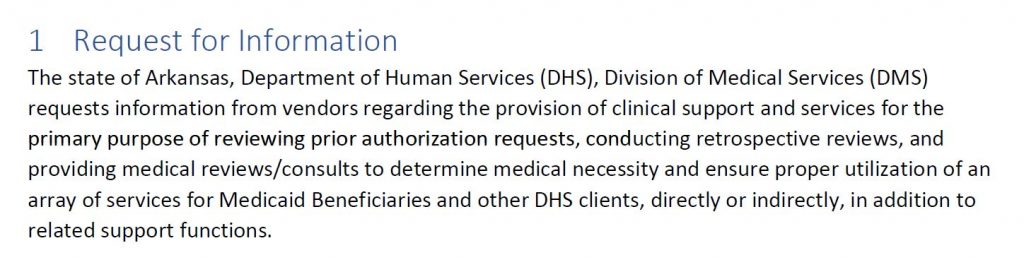
The state of Arkansas, Department of Human Services (DHS), Division of Medical Services (DMS) requests information from vendors regarding the provision of clinical support and services for the primary purpose of reviewing prior authorization requests, conducting retrospective reviews, and providing medical reviews/consults to determine medical necessity and ensure proper utilization of an array of services for Medicaid Beneficiaries and other DHS clients, directly or indirectly, in addition to related support functions.